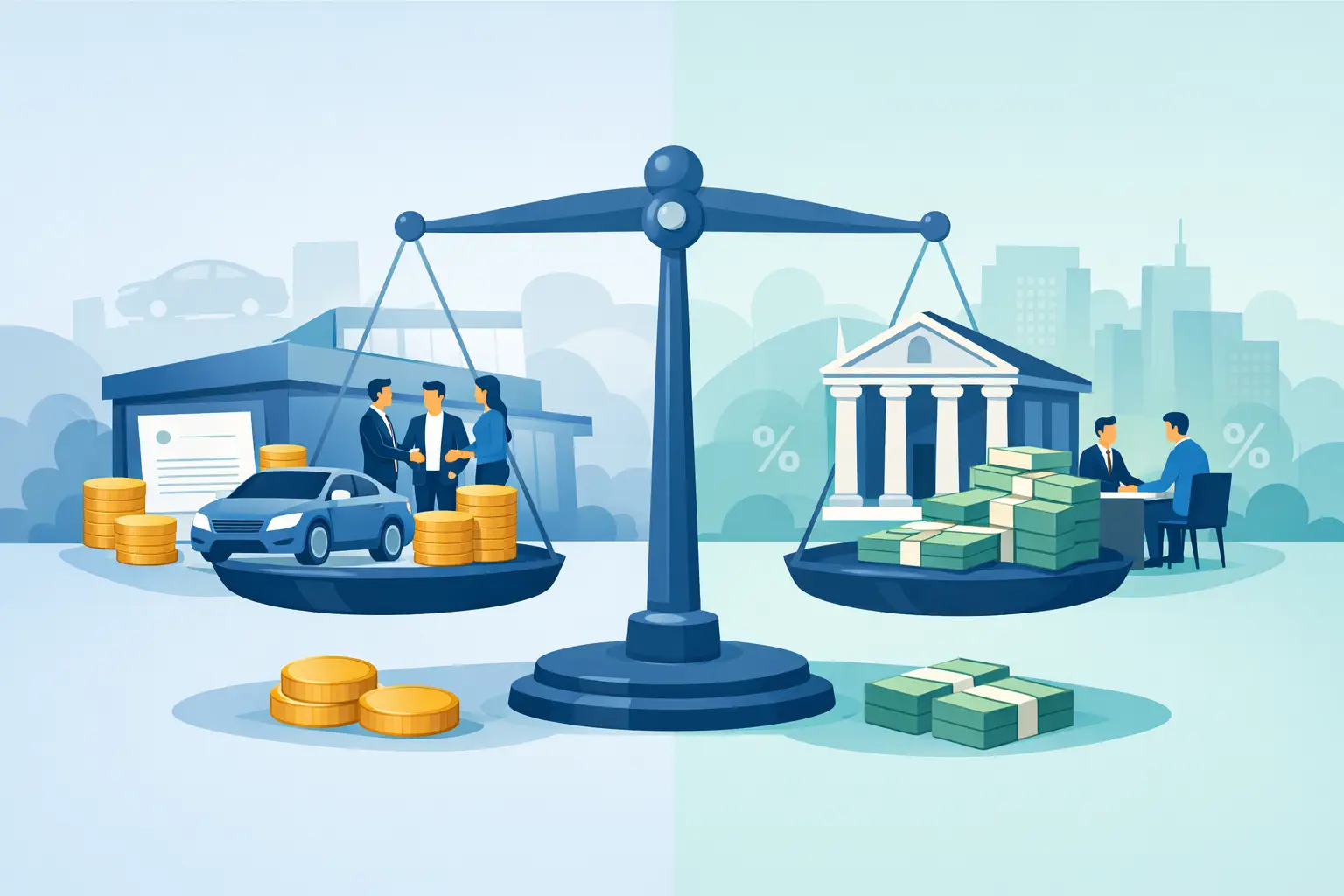
The finance office is where a car deal can change fast. A vehicle that looked affordable on the lot can become far more expensive once the payment, loan term, add-ons, and interest rate hit the worksheet. In the dealer financing vs bank loan decision, the best choice is not always the one with the lowest monthly payment. It is the one that gives you a fair total cost, terms you understand, and the freedom to say no to a bad deal.
For many buyers, getting financing feels like a step to handle after finding the right car. That approach gives the dealer more room to control the conversation. Know your options before you sit down to sign. You will be in a stronger position to negotiate the vehicle price separately from the loan.
Dealer Financing vs Bank Loan: The Real Difference
Dealer financing usually means the dealership sends your credit application to one or more lenders. The dealer is not necessarily lending its own money. It is arranging an indirect auto loan through a bank, credit union, or finance company.
A bank loan is typically direct financing. You apply with your bank, credit union, or another lender yourself, receive approval or preapproval, and bring that financing to the dealership. You can then compare the dealer’s offer against a number you already know.
The distinction matters because the dealer may have flexibility in the rate it presents to you. A lender might approve you at one annual percentage rate, while the dealership offers a higher rate. The difference can compensate the dealer for arranging the loan. This is often called a rate markup or dealer reserve. It is not automatically part of every deal, but it is one reason buyers should compare offers instead of accepting the first payment quote.
Dealer financing can also come with manufacturer-backed promotional rates, such as 0% APR or low APR for qualified buyers. Those offers can be excellent. They can also come with tighter credit requirements, shorter loan terms, or a trade-off: you may have to choose between the low-rate financing and a cash rebate. Read both scenarios down to the total amount financed before deciding.
When Dealer Financing Can Be the Better Choice
Dealer financing is worth considering when it genuinely beats your outside offer on APR and loan terms. That can happen with manufacturer incentives, especially on new vehicles. If you qualify for a promotional rate, the dealer’s financing may cost significantly less than a standard bank loan.
It can also be convenient. You may be able to finalize the vehicle and loan in one visit rather than coordinating funding with an outside lender. For a busy buyer, that convenience has value, as long as it does not replace comparison shopping.
A dealer may also have access to lenders that work with a wider range of credit profiles. If your credit history is limited or your score has taken a hit, the dealer could find an approval you did not locate on your own. That does not mean you should take the first approval offered. It means you should inspect the rate, loan length, lender, and every optional product before signing.
The strongest dealer-financing scenario is simple: the APR is competitive, the loan term fits your budget, there are no unwanted products folded into the deal, and you have checked the offer against at least one independent option.
When a Bank Loan Gives You More Control
A preapproved bank or credit-union loan gives you a clear benchmark before dealership pressure enters the conversation. You know the maximum amount you can borrow, the expected APR, the term, and often the estimated payment. That makes it harder for a salesperson or finance manager to shift your attention away from the actual cost of the vehicle.
Outside financing can also help you negotiate more cleanly. If you already have funding in place, you can focus on the out-the-door price – the vehicle price plus taxes, title, registration, documentation fees, and required charges. You are less likely to get pulled into a conversation that starts and ends with, “What monthly payment are you trying to stay under?”
That question is not harmless. A dealer can lower a monthly payment by extending the loan from 60 months to 72 or 84 months. Your payment may look manageable, but you could pay more interest and stay upside down on the loan longer. Being upside down means you owe more than the vehicle is worth, which creates a problem if you need to sell, trade, or replace the vehicle after an accident.
A bank loan is not automatically cheaper, though. Rates depend on your credit, income, debt, down payment, vehicle age, and loan term. Some banks also have stricter rules for older cars, high-mileage vehicles, private-party purchases, or vehicles sold outside your state. Ask about those limits before you get attached to a specific car.
Compare the Total Cost, Not Just the Payment
The loan offer with the lowest payment is not necessarily the cheaper offer. To compare financing honestly, put the offers side by side and look at the same details for each one.
Start with the APR, not just the interest rate. APR is the broader cost measure because it can reflect certain finance charges. Then look at the term. A 72-month loan may have a lower payment than a 60-month loan, but the longer loan will often cost more in total interest.
Next, check the amount financed. This is where extras can hide. Extended warranties, GAP coverage, tire and wheel protection, service contracts, paint protection, and other products may be useful in some situations. They should never appear on your contract simply because they were rolled into a payment you agreed to verbally.
Finally, calculate the total of payments. Multiply the monthly payment by the number of payments, then add any required upfront loan fees. This number shows what the loan costs over time. It is one of the quickest ways to spot a deal that looks cheap monthly but is expensive overall.
A quick example
Suppose you finance $30,000. At 7% APR for 60 months, the payment is about $594 and the total of payments is about $35,640. At the same rate for 84 months, the payment drops to about $453, which may sound appealing. But the total of payments rises to about $38,052.
That lower payment costs roughly $2,400 more over the life of the loan. The exact numbers will vary, but the lesson holds: term length matters as much as the payment.
Watch for These Finance-Office Pressure Points
You do not need to assume bad intent to protect yourself. You do need to slow down when the numbers become vague. Ask for a printed or digital breakdown of the deal before you sign, and take the time to read it.
Be especially careful when a dealer says financing is required to receive a particular vehicle price or rebate. Sometimes that is legitimate because a manufacturer incentive is tied to financing. Sometimes the explanation is muddy. Ask whether you can refinance immediately, whether any incentive would be clawed back, and whether the sale price changes if you use your own lender.
Also ask whether the loan has a prepayment penalty. Most mainstream auto loans do not, but do not rely on assumptions. If there is no penalty, dealer financing may still be a useful tool even if you plan to refinance later. Just make sure refinancing would actually lower your cost after considering the new lender’s terms and any delay in getting the process completed.
Do not sign a blank form, a contract with missing figures, or paperwork you have not been given time to review. If a number differs from what was discussed, stop. A rushed signature is not a small detail when you are committing to years of payments.
A Smart Way to Shop Both Options
Apply for financing with your own bank or credit union before visiting the dealership. Use that approval as your baseline, not as a reason to stop comparing. Then let the dealer try to beat it.
When you ask for the dealer’s offer, give the same basic loan parameters: similar down payment, amount financed, and term. Comparing a dealer’s 84-month offer to a bank’s 60-month offer tells you very little. Ask for the APR, monthly payment, number of payments, total of payments, and every item included in the amount financed.
Keep the purchase price negotiation separate from financing whenever possible. Agree on the out-the-door price first. Discuss trade-in value separately, too. Combining all three figures into one monthly-payment conversation makes it much harder to see where the deal changed.
If the paperwork feels confusing or the numbers do not match the verbal deal, get an independent second opinion before you commit. Auto Ally Marketplace can help buyers review a deal and identify questions worth asking before the pressure of the signing table turns into a long-term financial mistake.
The Better Loan Is the One You Can Verify
Dealer financing may beat a bank loan. A bank loan may give you more leverage and clearer control. Neither option wins by default.
The buyer who comes out ahead is the one who compares equal terms, checks the total cost, and refuses to let a monthly payment hide the real price. Take your time with the contract. A car can be exciting, but the loan deserves the same careful attention as the vehicle itself.