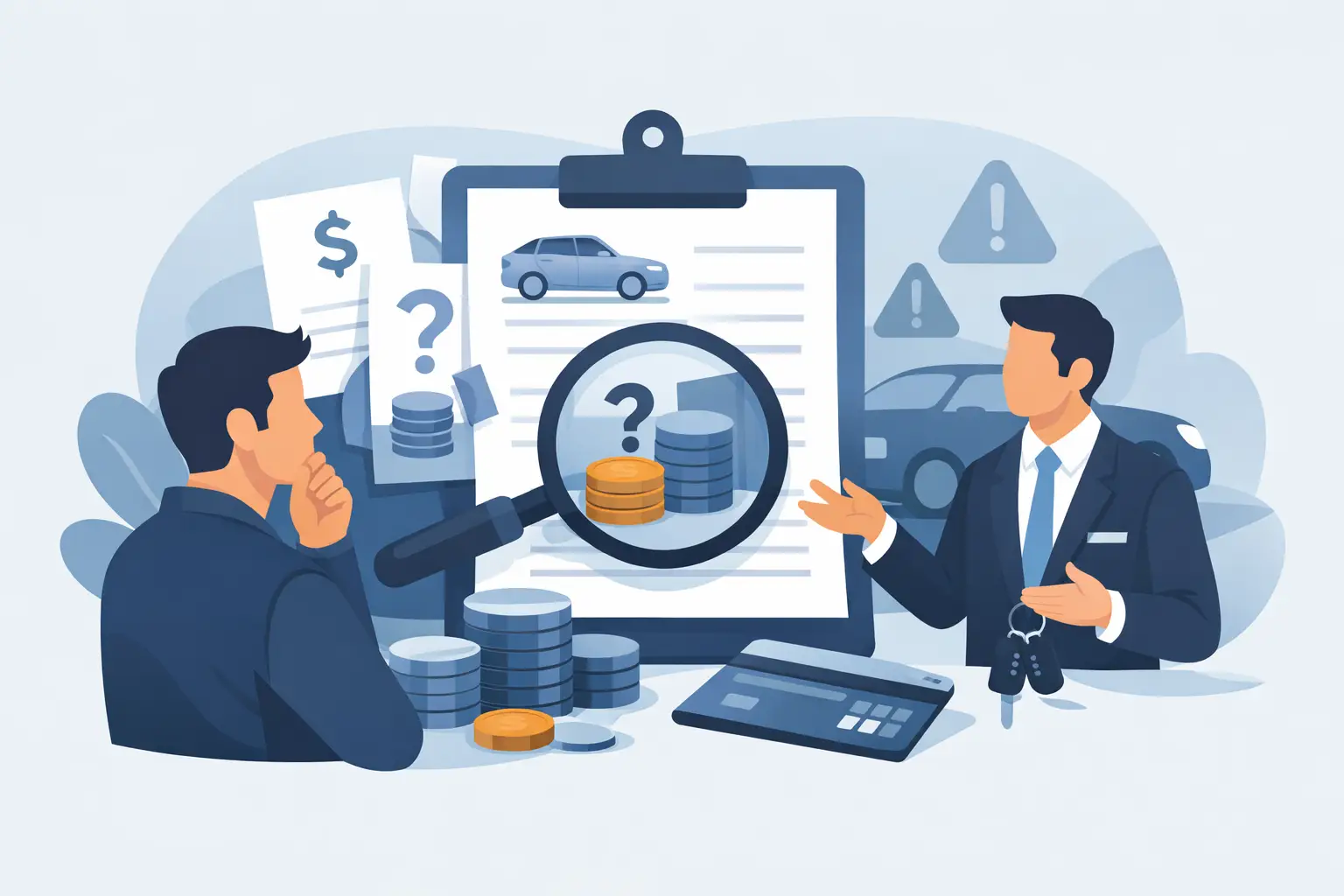
A car price can look fair right up until the dealer slides over the final worksheet. Suddenly there is a reconditioning fee, a protection package you did not ask for, a documentation charge that seems inflated, and a monthly payment pitch designed to distract you from the real total. If you want to know how to avoid hidden dealer fees, the key is simple: slow the deal down, force every charge into the open, and treat the out-the-door price as the only number that matters.
Most buyers do not get trapped because they are careless. They get trapped because dealerships control the pace, the paperwork, and the language. Fees are often introduced late, bundled into financing, or framed as standard when they are really optional, negotiable, or just plain padded. The good news is that once you know where these charges usually show up, they become much easier to challenge.
Why hidden dealer fees catch buyers off guard
The biggest mistake buyers make is focusing too early on the sticker price or monthly payment. Dealers know this. A car listed at a competitive price can still become an expensive deal after add-ons, administrative charges, and financing markups appear in the final numbers.
This is why smart buyers stop asking, “What is the payment?” and start asking, “What is the total out-the-door price before I sign anything?” That shift changes the conversation. It makes it harder for unnecessary fees to hide inside a long contract or a stretched loan term.
Some fees are legitimate. Sales tax, title, and registration are real costs. In many states, a documentation fee is also common, though the amount can vary a lot. The problem is that many dealers mix legitimate charges with questionable ones and present them all as unavoidable. They count on the buyer not knowing the difference.
How to avoid hidden dealer fees before you visit
Your leverage is strongest before you set foot in a showroom. Once you are sitting at the desk, invested in the car, and thinking about driving it home, it becomes much harder to push back.
Start by asking for a written out-the-door quote. Not an estimate. Not a screenshot of the listing price. Ask for a full breakdown that includes vehicle price, dealer fees, taxes, registration, and any add-ons already attached to the car. If they will not provide that in writing, treat it as a warning sign.
You should also ask one direct question: “Are there any dealer-installed accessories, protection packages, or required add-ons included in this price?” The wording matters. Dealers sometimes avoid the word fee, because they know buyers are watching for it. Instead, they package charges as products or services.
If you are shopping at multiple stores, compare out-the-door quotes, not advertised prices. A dealer with a higher listed price can still be the better deal if another store is burying you in extras. This is where independent deal review support can save you money fast, especially if the numbers feel intentionally confusing.
The most common hidden dealer fees
Not every extra charge is fake, but plenty of them deserve scrutiny. Documentation fees are common, but some stores use them to add hundreds of dollars in profit. Reconditioning fees are especially questionable on used cars, because preparing the vehicle for sale is generally part of a dealer’s business cost, not something that should surprise you later.
Then there are add-ons dressed up as protection. Window etching, nitrogen in tires, paint sealant, fabric protection, anti-theft packages, wheel locks, and VIN labeling are often presented as already installed and therefore non-negotiable. That does not mean they are worth the price. In many cases, the markup is extreme.
You may also see advertising fees, market adjustment fees, electronic filing fees, and dealer preparation charges. Some of these are just renamed profit centers. Others may be legal in one state and restricted in another. The point is not to memorize every possible charge. The point is to question every line item you do not understand.
What to say when a fee appears
You do not need a perfect script. You need clear, calm language.
When a fee shows up, ask, “What exactly is this for? Is it required by the state, required by the lender, or set by the dealership?” That question forces the seller to separate government fees from dealer-created charges. If the answer is vague, keep going.
Then ask, “Can this be removed? If not, why not?” Optional products often become very removable once the dealer realizes you are not rushing. If they say an add-on is already on the car, ask whether the price of the vehicle can be reduced by the same amount. You are not arguing about the product. You are arguing about paying for something you did not request.
If they pivot to monthly payment, bring it back to total cost. Say, “I am only reviewing the out-the-door price.” This helps prevent fee padding from being hidden inside financing.
How financing can hide dealer fees
Some of the most expensive surprises do not appear as obvious line items. They show up in the loan.
Dealers can make money by marking up the interest rate offered by the lender. They can also roll in service contracts, GAP coverage, maintenance plans, and other products that raise the total amount financed. A buyer who only looks at the monthly payment may not realize how much extra is being added.
That does not mean every finance product is bad. GAP can make sense in certain situations. Extended coverage can be worth considering for some vehicles and ownership plans. But it depends on the price, the terms, and your risk tolerance. The problem is pressure, not the mere existence of the product.
Protect yourself by getting preapproved before you shop whenever possible. A preapproval gives you a baseline rate and reduces the dealer’s ability to frame financing as a mystery. When you review the finance contract, check the amount financed, the APR, the total of payments, and every optional product listed. If you did not ask for it, do not assume it belongs there.
How to avoid hidden dealer fees during the test drive and negotiation
The moment after a test drive is when many buyers lose control of the process. Emotions rise, urgency increases, and the salesperson starts moving fast. This is exactly when you should slow down.
Before discussing payment or trade-in, ask to see the buyer’s order or price worksheet with every charge listed. Do not rely on verbal promises. If the salesperson says, “We will work that out later in finance,” that is not a small detail. That is the detail.
It also helps to keep each part of the deal separate. Negotiate the vehicle price first. Then review dealer fees. Then discuss your trade-in if you have one. Then financing. When everything gets blended together, it becomes easy for the dealer to give on one point while quietly taking more on another.
If a fee feels wrong, be willing to leave. That is not a bluff unless you make it one. Walking away is often the cleanest way to avoid paying for padded charges, especially when a store keeps insisting that obvious add-ons are mandatory.
Watch for pressure tactics that make bad fees easier to slip in
Hidden fees are rarely just a paperwork issue. They are often paired with pressure.
You might hear that another buyer is interested, that the deal is only good today, or that a manager has already approved a special discount. The goal is to make you feel that questioning fees could cost you the car. For most buyers, that fear is what closes the gap between skepticism and signature.
A good dealership should be able to explain every charge without drama. If you are being rushed, interrupted, or redirected every time you ask for a breakdown, that is useful information. Transparency should not require a fight.
This is one reason buyers seek outside guidance before signing. A second set of eyes can spot patterns that are easy to miss when you are in the middle of the sale. Auto Ally Marketplace exists for exactly that kind of support – helping buyers review deals clearly before a confusing quote becomes an expensive mistake.
When a fee is legal but still a bad deal
Some buyers assume that if a fee is legal, they have to accept it. Not necessarily.
A dealer may be allowed to charge a documentation fee, but that does not automatically make the overall deal competitive. One store may charge a high doc fee and discount the car price to compensate. Another may charge the same fee on top of an already inflated price. The fee itself is only part of the picture.
That is why the out-the-door number matters more than winning any single argument. You do not need every fee removed to get a fair deal. You need the total transaction to make sense compared with other options in your market.
A smart buyer stays flexible on tactics and firm on outcome. If the dealer wants to keep a fee, fine. They can lower the sale price instead. If they will not do either, you have your answer.
The strongest move you can make is refusing to reward a confusing deal. When the numbers are clear, fair, and fully disclosed, buying a car gets a lot less stressful.