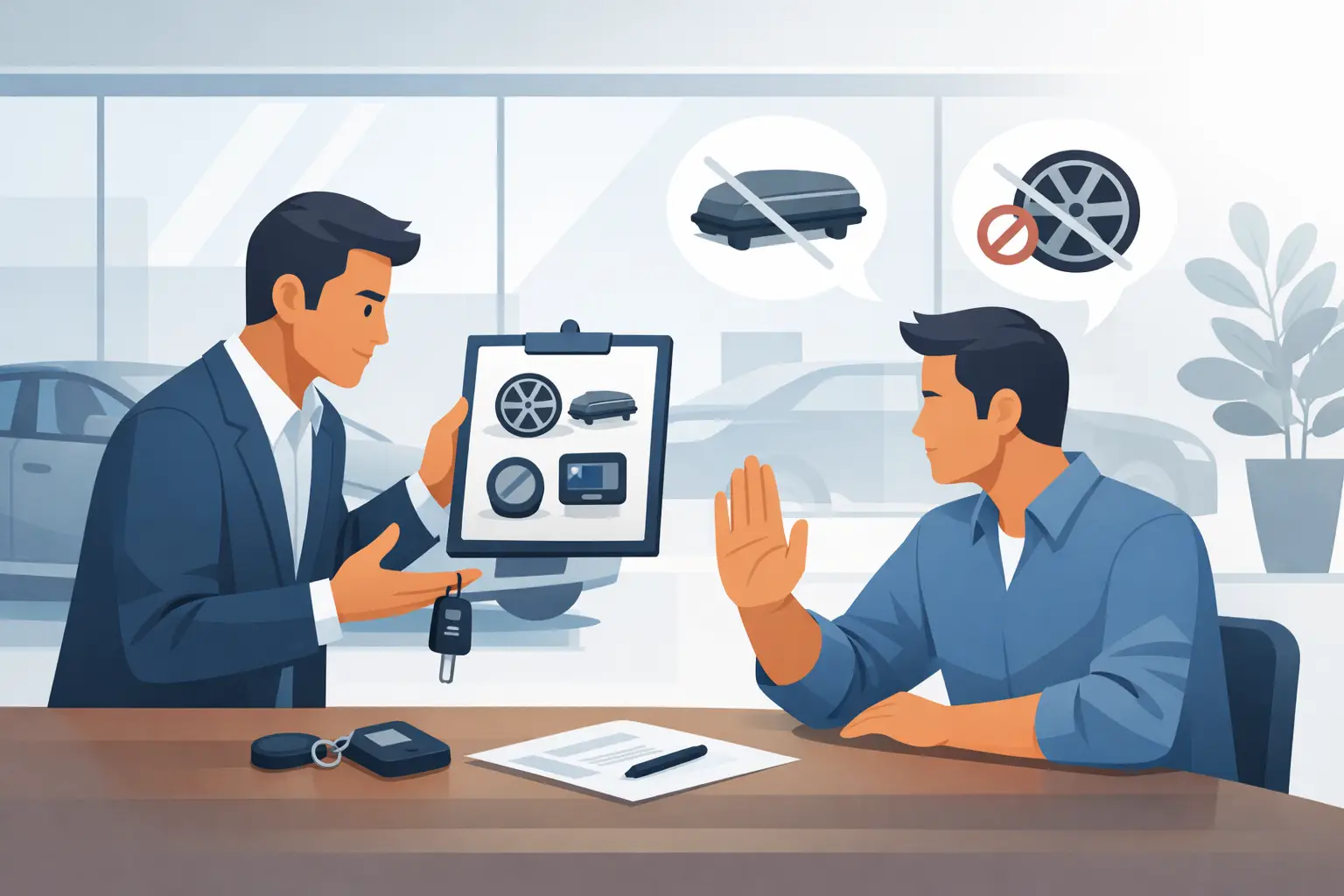
A new-car deal can look settled until the dealer presents a window etching package, nitrogen-filled tires, paint protection, wheel locks, or a prepaid maintenance plan. The pressure often arrives late, when you are tired, excited, and close to getting the keys. Knowing how to refuse dealer accessories gives you a simple way to protect your budget without turning the purchase into an argument.
The key is to separate the vehicle you agreed to buy from products the dealership wants to sell you. Some accessories can be useful at the right price. Many are optional, overpriced, or available elsewhere for less. You do not owe a long explanation for declining them.
Know what counts as a dealer accessory
Dealer accessories are products or services added to the car or the deal beyond the vehicle itself, required government charges, and any price you already negotiated. They may be physical items, such as floor mats, tint, wheel locks, a cargo tray, or a security system. They can also be service packages, including paint and fabric protection, VIN etching, tire-and-wheel coverage, key replacement coverage, maintenance plans, and roadside assistance.
The label can make an add-on sound official. “Dealer-installed package,” “protection package,” and “market adjustment package” are still items you have the right to question. A dealer can choose what it installs before listing a vehicle, especially when inventory is tight. But that does not mean you have to accept a deal that includes it.
There is an important distinction: an accessory already physically installed may be harder to remove than a future service contract or a line item added in the finance office. Harder does not mean impossible to negotiate. It means your choice may be to negotiate its price, find a different vehicle, or walk away.
How to refuse dealer accessories clearly
Use short, direct language. The more you explain, the more openings you give a salesperson to counter every concern. You are not asking for permission. You are stating the terms under which you are willing to buy.
Try: “I’m buying the vehicle, not the add-on package. Please remove it from the buyer’s order.” If the accessory is already installed, say: “I understand it is installed. I will not pay an additional amount for it. If that cannot be removed from the price, I’ll continue shopping.”
For finance-office products, keep it even simpler: “No, I’m declining that coverage. Please show me the contract without it.” Then read the revised figures before signing.
A salesperson may ask why. You can answer once: “It is not in my budget,” or “I do not see the value at that price.” After that, repeat your decision. Calm repetition is more effective than debating whether a coating, warranty, or security product is worthwhile.
Ask for the out-the-door price before you visit
The strongest time to refuse add-ons is before you are sitting in the dealership. Request a written out-the-door price for the specific vehicle, including the selling price, dealer-installed accessories, dealer fees, taxes, title, registration, and any required charges. Ask the dealer to identify every optional item separately.
This does two things. First, it prevents a low advertised price from becoming a much higher number after surprise packages appear. Second, it gives you something concrete to compare with other dealers. A dealer may say an accessory is “only” $995, but the real question is whether you are willing to pay $995 more for that vehicle.
Do not rely on a monthly payment quote. A dealer can make add-ons seem small by extending the loan term or changing the rate. Focus on the total amount financed, the annual percentage rate, the number of payments, and the total of payments. Accessories financed over several years cost more than the sticker price because you pay interest on them.
Do not confuse optional add-ons with required costs
Dealerships do have charges they cannot simply erase, such as sales tax, title, registration, and state-required inspection or filing costs where applicable. Documentation fees may be permitted, though they vary by state and should be included when comparing offers.
Optional accessories are different. A dealership may insist that a package is “mandatory” on its cars. What that usually means is the package is mandatory if you choose to buy that particular unit from that dealer at that price. It is not a government requirement, and it does not make the product a good value.
Ask one clarifying question: “Is this required by law or required by the lender?” If the answer is no, ask for it to be removed. If the dealer says it cannot be removed because it is installed, ask whether the price can be reduced by the full accessory amount. Get the answer in writing.
Watch for accessories that appear in the finance office
The finance and insurance office is where many buyers add products they never planned to purchase. The presentation can feel like a final approval step rather than a sales conversation. It is still a sales conversation.
Before you go in, decide what you will consider and what you will decline. If you want to evaluate an extended warranty, GAP coverage, or prepaid maintenance, ask for the product name, coverage terms, exclusions, deductible, price, and whether it can be canceled later. Do not let a fast presentation replace a careful review.
Some products can make sense in specific situations. GAP coverage may be worth considering if you have little equity and a large loan balance. A manufacturer-backed service contract may be valuable for a buyer who plans to keep a vehicle long after the factory warranty ends. The point is not that every product is bad. The point is that the product must fit your ownership plan, coverage needs, and budget – not the dealer’s sales target.
If you need time to decide, say so. You can purchase many protection products later, and you can often compare independent options. A car deal does not become smarter because every decision is made in one afternoon.
Check the paperwork line by line
Your verbal “no” matters, but the signed paperwork controls the transaction. Before signing, compare the buyer’s order, loan agreement, and any product enrollment forms with the numbers you discussed. Look for vague descriptions such as “appearance,” “protection,” “security,” “theft,” “maintenance,” “warranty,” or “other.” Ask what each charge is and whether it is optional.
If you see an accessory you declined, stop the process. Say: “This was not part of my agreement. Please remove it and print the corrected paperwork.” Do not accept a promise that it will be fixed later. A correction is easiest before contracts are signed and funds are finalized.
Bring your own notes with the agreed vehicle price, trade-in allowance, down payment, financing terms, and out-the-door total. A trusted friend or independent deal reviewer can also help you spot changes when the paperwork gets complicated.
Be ready to walk away
Walking away is not dramatic. It is a normal consumer choice when a dealer will not honor the deal you want. Your leverage is greatest before you sign, take delivery, or leave a deposit that you have not fully understood.
If the dealership refuses to remove or fairly price an add-on, ask for your deposit terms in writing and leave. Another dealer may have a comparable vehicle without the package, or may be more transparent about its total price. The time spent finding a cleaner deal can cost far less than financing unwanted extras for years.
You do not need to win an argument about dealer accessories. You only need a vehicle and a contract that make sense for you. Stay focused on the full price, review every line before you sign, and remember that a respectful “no” is part of buying a car on your terms.